
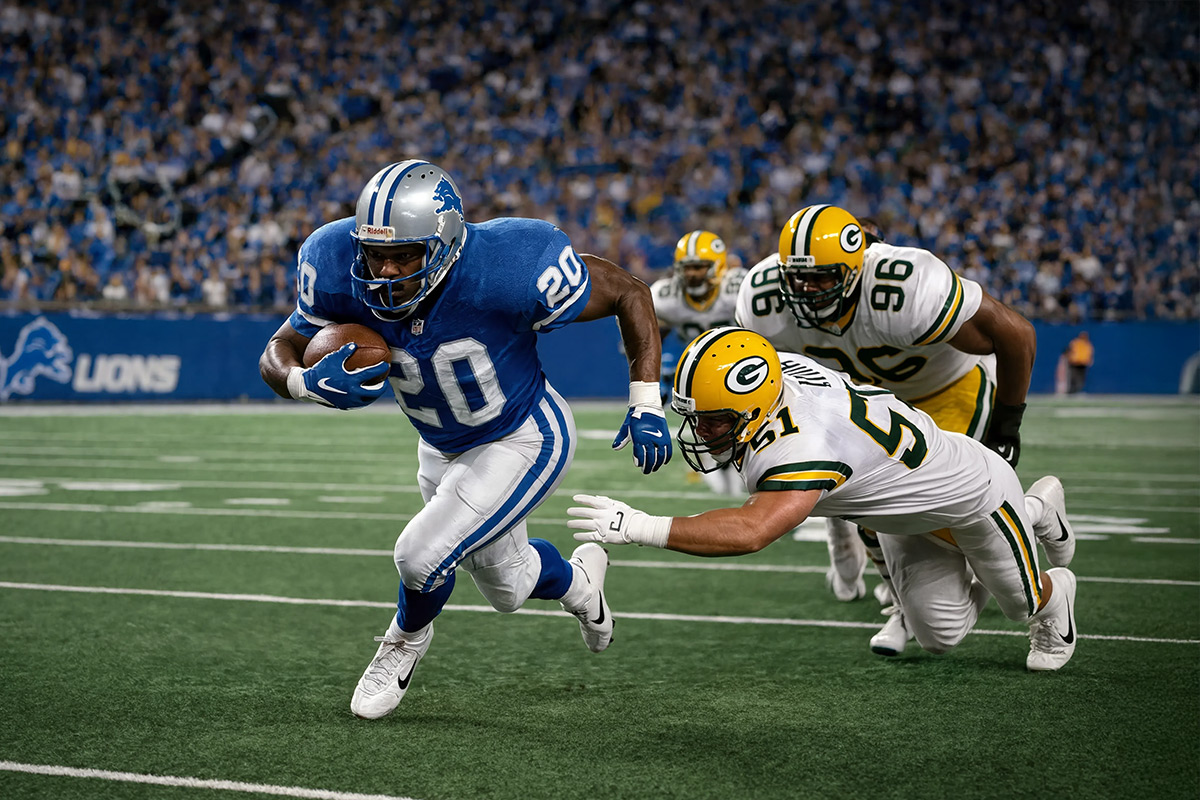
Barry Sanders is widely regarded as one of the greatest running backs in NFL history. He rushed for more than 15,000 yards, won an MVP award, made defenders look foolish on a weekly basis, and seemed destined to shatter Walter Payton’s all-time rushing record.
Instead, in July 1999, Sanders stunned the sports world by announcing his retirement at just 31 years old.
He wasn’t coming off a major injury. He wasn’t slowing down. In fact, he’d just rushed for 1,491 yards the previous season and remained one of the most feared offensive players in football.
So why did Barry Sanders walk away from the game at the height of his career?
The answer wasn’t one single event, it was years in the making.
Winning Meant More Than Records
For years, many fans assumed Sanders retired because he was tired of taking a beating or because he wanted to preserve his health. While those factors may have played a role, Sanders has since made it clear that his passion for football simply faded.
In Amazon’s 2023 documentary Bye Bye Barry, Sanders explained that he no longer had the same drive that fueled him throughout his career.
“For me, just that thing that drove me to play, which is that passion, just wasn’t there,” Sanders said. “There was nothing really left to play for. I didn’t see us as any kind of a serious Super Bowl contender.”
That quote may be the clearest explanation he’s ever given.
Frustrated With The Lions
The Detroit Lions had one of the greatest running backs to ever play the game, yet they never built a consistent championship contender around him. During Barry Sanders’ 10 seasons in Detroit, the Lions won just one playoff game.
After a disappointing 5-11 campaign in 1998, Sanders watched the organization move on from several key veterans, including Pro Bowl center Kevin Glover, one of his closest friends and a cornerstone of Detroit’s offensive line. Sanders later admitted those moves made him feel like the franchise was heading toward another rebuild instead of making a serious run at a championship.
Simply put, he didn’t want to spend another year carrying a team that wasn’t built to win.
Bobby Ross Wasn’t The Whole Story
Former Lions head coach Bobby Ross has often been blamed for Sanders’ retirement, and there was certainly friction.
Sanders reportedly wasn’t thrilled with Ross’ offensive philosophy, and his father publicly criticized the coach’s system, saying it didn’t maximize Barry’s unique running style.
However, Sanders has repeatedly said Ross wasn’t the primary reason he retired. In fact, he praised Ross as a coach in his autobiography and insisted his decision was much bigger than one coach or one season.
The Rushing Record Didn’t Matter
Perhaps the most incredible part of Sanders’ retirement is what he walked away from. He needed just 1,457 rushing yards to pass Walter Payton and become the NFL’s all-time leading rusher, a milestone virtually everyone expected him to reach.
Most players would have stuck around another season simply to own one of the game’s most prestigious records. Not Barry.
“I understood full well who Walter Payton was,” Sanders later said. “The record for me wasn’t important enough to force myself to stay around to try to get the record.”
That mindset perfectly captured who Sanders was throughout his career. He celebrated touchdowns by handing the ball to the referee. He rarely sought attention, endorsements, or personal accolades.
Winning mattered. Records didn’t.
A Retirement That Still Feels Unbelievable
Sanders’ retirement became even more shocking because of how it happened. Rather than holding a press conference, he boarded a flight to London and had his agent fax a brief retirement statement to his hometown newspaper, The Wichita Eagle, before informing much of the football world.
“My desire to exit the game is greater than my desire to remain in it,” Sanders famously wrote.
Twenty-seven years later, it’s still one of the most surprising retirements in NFL history.
What If Barry Had Kept Playing?
It’s one of football’s greatest “what if” questions. Another season almost certainly would have made Sanders the NFL’s all-time rushing leader if he stayed healthy. Two or three more productive years might have put his record out of reach for decades.
Instead, he chose happiness over history.
In an era when athletes are often criticized for chasing contracts, records, and fame, Barry Sanders walked away from millions of dollars and one of football’s most iconic records because his heart simply wasn’t in it anymore.
Looking back, that decision may be one of the boldest and most Barry Sanders moves we’ve ever seen.




Show Your Team Spirit









Recent Comments